


On August 21, former Philippine men’s national basketball coach Rajko Toroman declared that this year’s national team is the “strongest team in the history of Philippine basketball.” These bold words, however, is wanting of results—the team’s performance in the ongoing FIBA World Championship will be the ultimate affirmation, or rejection, of Toroman’s pronouncement. History is providing us with a better hindsight of our century-long basketball tradition and armed with knowledge of the past, we can provide the six best nominees for the strongest Gilas of all time.
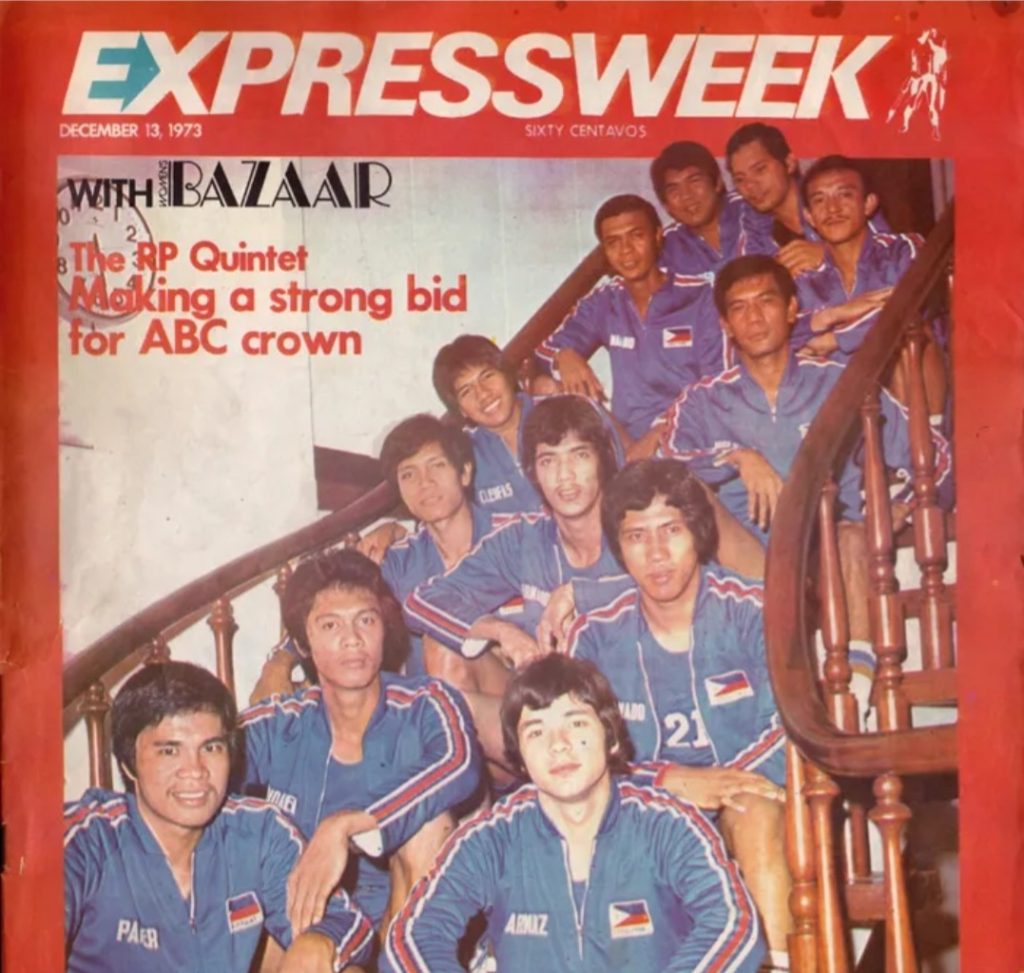
Today, we are examining the Philippine team in the 1973 Asian Basketball Confederation (ABC) Championship.
***
In making our case for the Philippines’ 1962 Asian Games squad as the strongest Gilas ever, we emphasized that the only objective metric for a team’s strength is winning. That Gilas was the winningest Filipino men’s basketball team in the Asiad to date, sweeping all seven games.
But that squad was easily surpassed by the team that participated in the 1973 ABC Championship in Manila. If winning is the only objective basis for strength, then that team rewarded the hometown crowd with a ten-game sweep.
Indeed, the Asiad is a much more prominent event than the ABC, being the quadrennial grand assembly of athletes from several sports in the continent. But one has to consider that the national basketball program had experienced some sort of a slump after the retirement of Caloy Loyzaga and his golden generation of hoopers. After their retirement, who are going to sustain the winning ways of Philippine basketball?
Philippine basketball was in a doldrums for the next decade. This meant two missed semifinals in the Asian Games, early elimination in two Olympiads, and two missed stints in the FIBA World Cup. The only high profile tournament where the Philippines was a consistent podium finisher was the biennial ABC Championship, but at that time South Korea and Japan have been breaking the Philippines’ basketball monopoly in Asia.
From 1962 to 1972, the ABC Championship was a rigodon of three countries: the Philippines, Japan, and South Korea. Our neighbors had raised the bar—that was the decade of the emergence of South Korean Shin Dong-Pa, who was Asia’s best shooter, and Japanese Shigeaki Abe, Asia’s best point guard. The Philippines, meanwhile, was a motley crew of talent with no standout leader.
But unbeknownst to many, the 1973 ABC squad would start the professionalization of Philippine basketball. And with basketball’s professionalization, the sport would become TV entertainment and would enjoy a popularity unmatched by Loyzaga’s generation.
“Big Boy” Alberto Reynoso skippered the squad, being the only remnant from Loyzaga’s era. Joining him were guards/wing men Joy Cleofas, David Regullano, Yoyong Martirez, Bogs Adornado, Tembong Melencio, and Francis Arnaiz. The big men were “Mr. Cool” Jimmy Mariano, “The Chairman of the Boards” Manny Paner, and the 6’6” tandem of Abet Guidaben and “El Presidente” Ramon Fernandez. But the heart and soul of this team was “The Big J” Robert Jaworski, who would quickly surpass Loyzaga as the Philippines’ most iconic hooper even to this very day. The head coach was La Salle’s champion coach in 1972, Tito Eduque.
The Filipinos were very hungry. For one, they were on a mission to regain our basketball monopoly in the continent. Two years prior, the Philippines were humiliated by home team Japan, 69-93, to lose the gold medal. Never did the Philippines lose by such a huge margin and it had been a four game losing streak against the Japanese for the past eight years. The baggage of being shamed by the Japanese in our favorite sport on a consistent basis was too much to handle for the 1973 squad. Losing against them on home soil was akin to being invaded by the Japs for a second time.
After sweeping the preliminaries with an average margin of 47 points, the Philippines had a rough start in the championship round, winning narrowly against Iran, 88-80. Worse, the next game would be the grudge match against Japan.
That time, the Filipinos unleashed hell, beating Nippon by 20 points, 89-68. Vengeance was served cold, against what was touted as the strongest Japanese squad to date.
The championship was far from over, with three games left to win. How did the Filipinos respond? A 37 point thrashing of Taiwan and a 26 point massacre of India. This led to the final match with fellow undefeated South Korea, with Shin Dong-Pa wanting a second ABC gold.
The de facto final was very competitive and high scoring for the first 20 minutes, as the first half ended at 48 each. But the Filipinos did drastic adjustments in the second half, particularly on defense. Melencio was tasked to man Shin in the second half, and his defense against Asia’s best scorer was the epitome of ‘70s Philippine basketball—physical, intimidating, dirty. In that half, the 6’1” Jaworski began to play point guard, a position he would embrace for the next 24 years of his long career. Adornado shot the Rizal Memorial Coliseum’s light out while Fernandez’s un-blockable teardrop shot from the low-post frustrated the Koreans.
With the win, the Philippines have returned to the Basketball World Cup for the first time in 15 years.
But more than that, two years later that team would found Asia’s first professional basketball league, the Philippine Basketball Association (PBA), ushering in the ultimate commercialization of Philippine basketball. This led not only to big bucks, but full TV coverage, commercial endorsements, and even acting gigs/political career for these players.
That said, the 1973 ABC champions ushered Philippine basketball to the modern era. They were the initial capital of a big business that only gets much bigger each year. Jaworski, Fernandez, Adornado and company became celebrities, nay, cultural icons. If the 1936 Olympic team and the 1950s generation of Loyzaga made basketball a national pastime, the 1973 team made basketball a religion.
Most importantly, this team remains to be the winningest Filipino team in international basketball history. This is a feat that may never be surpassed. Only the strongest Gilas of all time can accomplish this.
10-0. This record will stand the test of time. This team is the perfect 10.
* * *
