


On August 21, former Philippine men’s national basketball coach Rajko Toroman declared that this year’s national team is the “strongest team in the history of Philippine basketball.” These bold words, however, is wanting of results—the team’s performance in the ongoing FIBA World Championship will be the ultimate affirmation, or rejection, of Toroman’s pronouncement. History, however, is providing us with a better hindsight of our century-long basketball tradition and armed with knowledge of the past, we can provide the six best nominees for the strongest Gilas of all time.
Today, we are examining the Philippine team in the 1962 Asian Games.
***
What makes a great team the strongest? The Messianic ability to resurrect a dead program? Having the best achievement in the world’s biggest stage? Being like the diminutive King David slaying Goliath? Or having the most star-studded roster?
These are valid qualifiers in gauging the strongest. However, these are subjective.
But there is an objective truth to greatness. Winning.
As the cliche goes, you play to win.
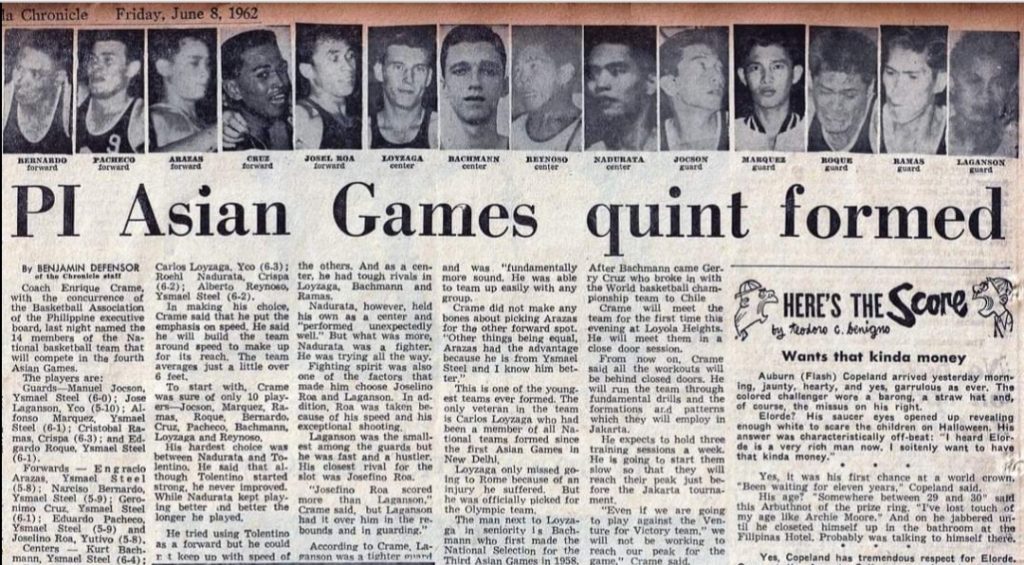
The 1962 Asian Games Gilas team is the best example of that metric. Simply put, they won seven games in the continent’s biggest stage. They lost zero.
It was of great help that this squad was stacked of globetrotters—Olympians, World Championship vets—the prime batch of Philippine basketball’s golden era.
Bannering this batch was the tisoy twin tower of Caloy Loyzaga and Kurt Bachmann, accompanied by spitfires Ciso Bernardo, Gerry Cruz, Boy Marquez, Engracio Arazas and that year’s PSA Most Outstanding Basketball Player Eddie Pacheco, who was also a national football player that year. Alberto “Big Boy” Reynoso was the youngest in the team and was the only member who made it to the Philippine Basketball Association (PBA).
That mentioned, this team was stacked, nevermind if “The Big Difference” Loyzaga was running on fumes. But what made them click was the cohesion and chemistry because this was basically the lineup of the Ysmael Steel Admirals, at that time the strongest team in the PBA’s predecessor Manila Industrial and Commercial Athletic Association (MICAA), save for a few from YCO Painters and Crispa Redmanizers. By that time, the sport’s sanctioning body Basketball Association of the Philippines put premium, not on getting the best athletes, but the best domestic team to represent the country—team over individual talent.
Coaching the squad was the obscure Enrique Crame, a coach who preferred a fast-paced offense and who did not mince words in his lineup choice.
The decision paid many dividends.
In the group stage, the Philippines made mincemeat of Southeast Asian neighbors Cambodia and Thailand by an average winning margin of 20 points. They then faced the big boys in the single-round robin finals, only to pad their winning margin by 30 points a game, including an 84-68 whipping of South Korea.
One rival stood in the way of the Philippines for the de facto championship match against fellow undefeated Japan.
The result, though, was anti-climactic as the nationals surely sent the Jakarta crowd packing midway into the second half, dispatching the Japanese by the buzzer, 101-67.
It does not help that the Internet could not provide robust information about that tournament, but one thing is for sure, all of the Philippines’ seven games were boring. Sports is one of humanity’s most profound storytelling devices, and what story can we eke out from that 1962 squad?
Just a four-peat. Continental domination for 12 years.
Heck, that was a longer dynasty than the Boston Celtics in the NBA, who ruled that side of the world for only 11 years. What’s staggering was that Boston’s dynasty was born out of intense struggle—tons of Game 7’s and overtime wins. The Philippines in that 12 year stretch? Nearly 30-point winning margins game in and game out. That dynasty was built upon the bones of Asian cagers who had the misfortune of poking the beast.
That 12-year dynasty was capped by the winningest Philippine national team ever in the Asian Games by being the only squad to win seven games.
That was the last basketball gold medal for the Philippines in the Asiad, a plum we haven’t won for 61 years, even if we employed the help of NBA stars in the recent two editions.
That was also the last hurrah of Philippine basketball’s Golden Generation—men who have experienced playing in the Olympics on the reg.
That generation saved the best for last: The strongest Gilas team we’ve ever known.
* * *
