


On August 21, former Philippine men’s national basketball coach Rajko Toroman declared that this year’s national team is the “strongest team in the history of Philippine basketball.” These bold words, however, is wanting of results—the team’s performance in the ongoing FIBA World Championship will be the ultimate affirmation, or rejection, of Toroman’s pronouncement. History is providing us with a better hindsight of our century-long basketball tradition and armed with knowledge of the past, we can provide the six best nominees for the strongest Gilas of all time.
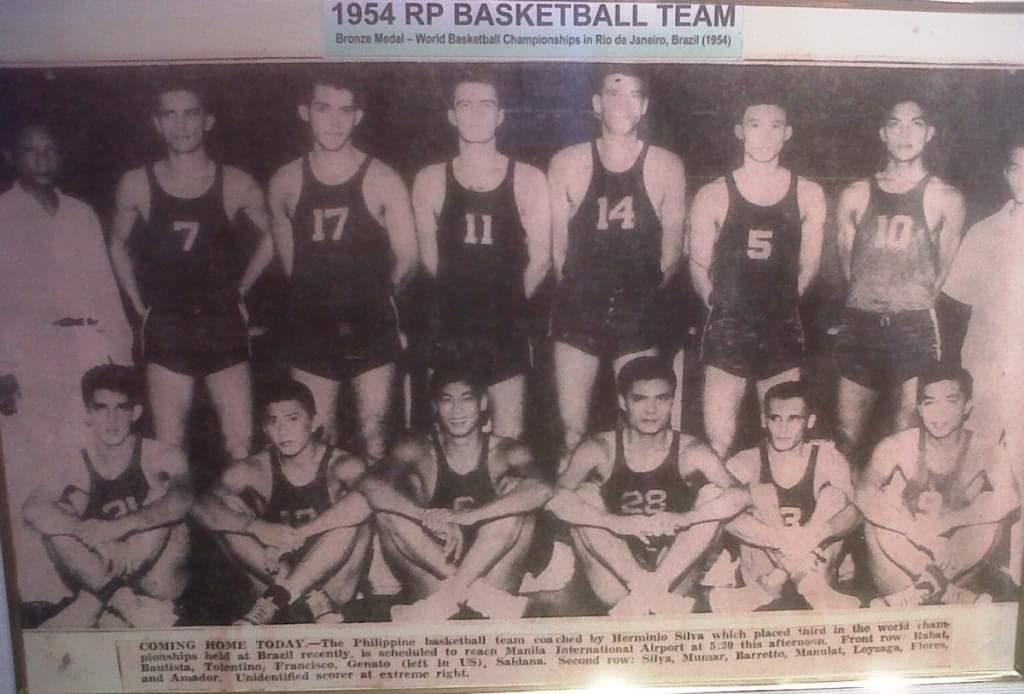
Today, we are examining the Philippine team in the 1954 FIBA World Championship.
***
As of this writing, the Gilas Pilipinas men’s national basketball team has notched its 12th loss in three appearances in the FIBA World Cup, the highest stage in all of basketball. Since their return in 2014 after a 36 year absence, the Philippines has managed to win a single game: Their last group assignment against Senegal nine years ago, via an 81-79 overtime squeaker.
That was not the case for the Philippine team in its golden era, the ‘50s. In its first two FIBA World Championships, Gilas got off with a winning start with 10 wins and five losses under the tutelage of legendary coaches Herminio Silva and Baby Dalupan.
Silva’s 1954 team would be the most special stint of all, as that campaign resulted in a bronze medal—the only podium finish by any Asian country in the history of the FIBA men’s basketball world championship.
Captained by Olympian and two-time Asian Games champion Lauro “The Fox” Mumar, he was accompanied by Francisco Rabat, Tony Genato, Ponciano Saldaña, Ramon Manulat, Florentino Bautista, Rafael Barretto, Mariano Tolentino, Napoleon Flores, Benjamin Francisco, and Bayani Amador.
These eleven men stood barely six feet and this team was reportedly the smallest in terms of height. But their lone big man, the versatile 6’3” center from San Beda College named Caloy Loyzaga, would prove to be the big difference for this vertically-challenged squad.
Held in Rio de Janeiro, the 1954 World Championship was among the most competitive in FIBA history. The Philippines had the privilege to belong to the world’s elite twelve in basketball, unlike today’s iteration of 32 teams—a third of which coming from obscure, non-basketball nations.
The Philippines was grouped with hometown power Brazil and neighboring Paraguay in Group A, which meant facing a hostile crowd in those two pivotal games. Defeating Paraguay in the opener, 64-52, the Filipinos were outclassed by Brazil, 62-99. Thankfully, Brazil pulled through against Paraguay in a competitive match, 61-52, to enable the Philippines to qualify in the final round robin stage.
Their next match was against a team that was twice as good as Brazil, the United States. Led by agile 6’6” forward Kirby Minter, the mighty Americans steamrolled, 56-43, as the Filipinos started with a 1-2 losing record.
But instead of demoralization, instead of just basking under the Rio sun and enjoying a beach holiday at the Copacabana to internalize their learning experience at their inaugural World Championship, Loyzaga and company vowed nothing but to win their remaining games.
The Philippines routed its next two games against Formosa (present day Taiwan) and Israel before falling again to Brazil, 41-57. That loss was particularly deflating since Gilas would next face Canada, France, and Uruguay that were at least as good as the Brazilians.
In the game against Canada, Mumar, the veteran internationalist who has played so inconsistently in this World Cup, found his shooting touch again as he torched Canada with 24 points en route to an 83-76 upset.
With just a game ahead of France in the standings, the Filipinos goal was set to get the bronze medal in a virtual battle for third against France in the penultimate fixture. The French were towering, led by 6’9” Jean Paul Beugnot yet Loyzaga played the game of his life and topscored with 19 points whilst limiting his giant opponent to only 10 points.
With a nip-and-tuck affair for almost the entire match, it was Mumar who scored the go-ahead fastbreak layup, in “The Fox” fashion, en route to a 66-60 thriller.
That was the most important win of any Philippine men’s basketball in history. Our puny, colonized nation has reached the pinnacle of a sport that only giants can achieve. No other Philippine team, or any Asian men’s team, has smacked a medal of a basketball world championship.
Yes, this achievement might have been forgotten by the new generation of Pinoy hoopers and fans. This team was so forgotten that in today’s mass opinion, basketball is seen as a sport that does not fit the Filipino physique. This despite matching the height of Western nations, with the current lineup composed of three 6’10” and a 7’3” beanpole, with an average height of 6’3” among wing men. Back when we won the world bronze, 6’3” was the height of our only big man.
And that only big man became one of two Asian men to be named in the FIBA World Cup Mythical Five, the other being 7’6” Yao Ming from China. With that distinction, Caloy Loyzaga became the greatest Filipino basketball player of all time. His 31 points in the final game versus Uruguay was the second highest score by a Filipino player in the basketball World Cup. He would later skipper the 1962 Asian Games team that won seven games. His GOAT status lingered even as a coach, mentoring the 1967 ABC gold medal squad and assisting Enrique Crame to sweep the 1973 ABC tournament, winning all ten games. To this day, Loyzaga remains the greatest of all time, being the only Filipino cager inducted in the FIBA Hall of Fame just this month.
What was the secret of the 1954 Gilas? It was more than puso. It was iron discipline, court smarts, tenacity, hustle, that Napoleonic confidence of smaller men, and most importantly, team play. More than the FIBA Worlds bronze medal, these timeless virtues were the big difference for the strongest Gilas to have ever graced the hardcourt.
* * *
