


On August 21, former Philippine men’s national basketball coach Rajko Toroman declared that this year’s national team is the “strongest team in the history of Philippine basketball.” These bold words, however, is wanting of results—the team’s performance in the ongoing FIBA World Championship will be the ultimate affirmation, or rejection, of Toroman’s pronouncement. History is providing us with a better hindsight of our century-long basketball tradition and armed with knowledge of the past, we can provide the six best nominees for the strongest Gilas of all time.
Today, we are examining the Philippine team in the 1936 Olympics.
***
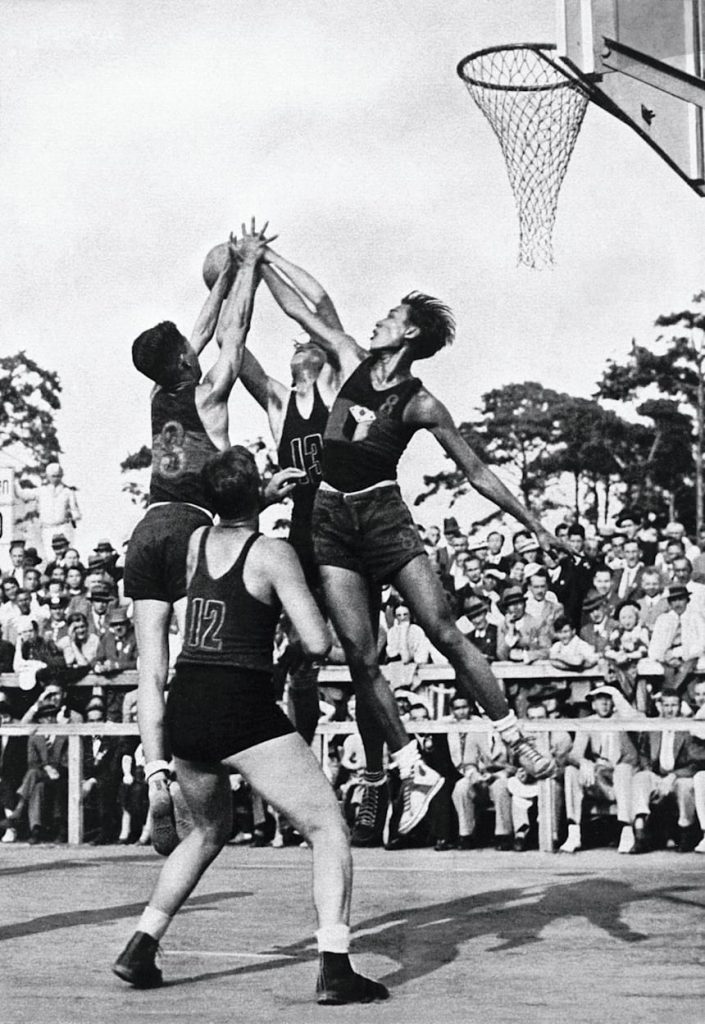
The Philippine men’s national basketball has had the pleasure of participating in the Olympics—the world’s grandest stage in sports—seven times. In those seven stints, the inaugural 1936 squad—dubbed as the Islanders—had the highest rank (5th) and win-loss record (4-1) among our seven Olympic teams.
Skippered by young lawyer Ambrosio Padilla of the University of the Philippines Fighting Maroons, the squad, dubbed as Islanders, was composed of “Jumping Jack” Ciria Cruz, Franco Marquicias, Primitivo Martinez, Jesus Marzan, Amador Obordo, Bibiano Ouano, Fortunato Yambao, and Filipino-American center Charles Borck. The reserves were Antonio Carillo, Miguel Pardo, and Fil-Am John Worrell. The head coach was the Philippines’ finest sports polymath Dionisio Calvo.
Among the nine in the active roster, only Charles Borck measured above six feet—6’1” to be exact. The rest were just a little bit taller than the average Filipino. Its most skilled player, Ciria Cruz, is said to have measured at 5’5”. The Philippines were midgets compared to eventual gold medalist United States (U.S.), which had three players at 6’8”—giants among mortals during that era—with their smallest at 5’11”.
The Filipinos had to endure one month of sea travel from Manila to Germany and had to battle sea-related sicknesses and, most of all, stay in game shape during the voyage.
Aside from the physical toll, the Filipinos also had to deal with the psychological baggage of playing in Nazi Germany, a global scourge at that time considering its totalitarian rule.
Worse, Berlin staged its basketball tournament in an outdoor tennis claycourt, during unpredictable weather. The balls used were rickety and heavier than today’s. According to U.S. team captain Bill Wheatley, “The ball was a lot bigger and heavier than the ones they have today, and there was a slit on one side where you put in the bladder. No matter how tight you laced up that opening with rawhide, there was no way to make that ball perfectly round.”
The clay surface did not allow for a higher and quicker bounce, making it very hard to dribble. When it rained, the court became so muddy and slippery and it was practically impossible to grip the oversized ball. As such, the games seemed to be a throwback of the old Naismith rules, which then disallowed dribbling. And indeed, some aspects of the antiquated rules were still in effect, most notably having a jumpball after every made basket, instead of today’s alternating possessions.
Despite the frustration of Western countries of the dismal playing conditions, this worked very well for the Filipinos, who were so accustomed to outdoor street basketball, even in adverse weather. The Filipinos were the only ones delighted to play that way as they upset eventual bronze medalist Mexico, 32-30, in the opener, then demolishing Estonia, 39-22, in the next round.
However, that retained Naismith rule—jumpball after every made basket—became sorely disadvantageous for the Islanders in their quarterfinal match against the U.S., as Borck had no match against the 6’8” giants of America, with the Americans getting almost all of the possessions while the Filipinos had to rely on forcing turnovers.
The result was a 23-56 thrashing by the Americans—the Philippines’ only loss in that Olympics.
Unfazed, the Filipinos showed their supremacy in the consolation rounds, trouncing Italy, 32-14, and Uruguay, 32-23, for fifth place. The Philippines would appear in six more Olympics, with its last basketball stint in 1972.
Despite a steep decline in basketball starting in the ‘70s, the Philippines remains to be the highest-ranked Asian country in Olympic men’s basketball for 87 years and counting. They are also the only Asian men’s basketball squad to have beaten an eventual Olympic medalist. We have that 1936 Islanders team to thank for. But can we say that they are the strongest Gilas ever?
One might say that the Islanders played primitive basketball, back when the sport was still not competitive on a global scale as it was played only among U.S. puppet states. Another argument is that those lolos cannot stand a chance among today’s hoopers if we transport them to our present age via a time machine.
First of all, to this day, millions of Filipinos play their hoops on unmarked muddy ground and even on potholed or inclined pavements, using makeshift baskets and dilapidated balls, and that kind of basketball has been played by our ancestors more than a century ago, down to our modern age. Heck, the likes of CJ Perez, Rhenz Abando, and RR Pogoy have played kanto or bukid ball during their childhood days and they still carry that heritage in today’s World Championship.
As for competition, it has to be stressed that by 1936, basketball had become a global sport. Asia was represented by two other teams—China and Japan—which were not under American influence. Football crazy Latin America had five representatives; Eastern Europe had three, and Africa its sole national squad in Egypt. It was a delight that basketball’s founder, James Naismith, was present in Berlin to witness the globalization of his sport.
Generational differences cannot also be used as an argument in measuring the strength of a basketball team. Playstyle was very much different back then (palming the basketball on the dribble was a carry and the gather step was not allowed). There was also no shotclock and three-second violation in Berlin so a leading team can just weave the ball to eternity while lumbering big men could just patrol underneath the basket with impunity. For sure, if we transport our current players to 1936, they would have an awful time adjusting to those rules while the oldies would surely sizzle playing with modern equipment and rules.
All things considered, the 1936 Philippine Islanders is the strongest Gilas ever, not only for being the continent’s best in the Olympics, but because they transcended their era. We have them to thank for making basketball the most popular sport in the Philippines—even more popular here than it is in the United States.
Most importantly, the1936 Philippine Islanders is the strongest Gilas ever for it is composed, not only of respected, gallant men, but literal heroes. Ciria Cruz and Obordo offered their lives for our liberty, dying in battle against the Japanese invasion in World War II. Team captain Padilla became a senator, out of being a defender of democracy and not because he was a basketball celebrity, steadfastly opposing the Marcos dictatorship. Finally, head coach Calvo became the founder of the Asian Basketball Confederation (now FIBA Asia) and was the first Filipino member of the FIBA Hall of Fame.
They say the newer versions will always be better than the original given the advancement of human civilization and technology.
In the case of Philippine basketball, however, the original remains to be the best.
* * *
